

Contents
The short answer: Etsy’s updated Terms of Use take effect on 16 December 2026. They let Etsy, together with its partners and vendors, use what sellers upload (photos, descriptions, titles) to develop, train, test and improve artificial intelligence. After a wave of seller protests, Etsy added a promise on 23 November not to train models designed to copy your work or replace your creativity. The licence itself is still very broad, it cannot be withdrawn, and there is no opt-out setting. If you make art, prints, crafts or digital designs, this is a good moment to open your own online shop next to Etsy, on rules you set yourself.
Below you will find what exactly changes, what Etsy promises and what it does not, whether you can opt out, seven things to do before 16 December, what Etsy really costs you per sale, and the main Etsy alternatives. Every fact about the new terms is linked to a source at the end of the article.
Etsy’s new AI policy: the timeline
- 26 October 2026: Etsy publishes its yearly update to the Terms of Use. The licence that sellers give Etsy over their content now says Etsy, along with its partners and vendors, may use that content to develop, train, test and improve AI and machine-learning technology. That version still says AI training is subject to opt-out rights described in the Privacy Policy.
- Mid-November: sellers push back hard. Some long-time sellers, including one shop that had been open for 13 years, close their shops in protest. On 16 November Etsy defends the change on its community forum.
- 20 November: Etsy tells the New York Times it will revise the wording.
- 23 November: Etsy publishes revised terms. It says it changed them „based on your feedback”: seller content will not be used to train AI models designed to copy original work or replace sellers’ creativity, and partners and vendors may not use it to imitate your items. The reference to opt-out rights is gone from this version.
- 16 December 2026: the new terms take effect. If you keep selling on Etsy after that date, you accept them.
Etsy says it uses AI for things like fraud detection, better search and recommendations, automatic translation of listings, tools for sellers, shop performance summaries and marketing. Some of that may genuinely help you sell. The issue is not that Etsy uses AI. The issue is how wide the permission is that you give every time you list your work.
What Etsy promises, and what it does not
The 23 November revision sounds reassuring, so it is worth reading slowly:
- The promise is about purpose, not about training. Etsy says it will not train models designed to copy your work. It can still train models on your photos and descriptions to „improve its services”, such as search, ads and translation.
- Partners and vendors are included. The licence covers Etsy and the companies it works with. Etsy says partners may not use your content to imitate your items, but the terms do not explain how that is checked.
- The licence is permanent. Industry analyses describe it as worldwide, royalty-free, perpetual and irrevocable. That means deleting listings or closing your shop may not take back the rights to content you have already uploaded. Etsy has not clearly explained what happens to deleted content.
- You still own your work. Your copyright stays with you. A licence does not transfer ownership, but it does let Etsy use your content within the terms you accepted.
Can you opt out of Etsy AI training?
Not in any simple way. There is no switch in your account settings that stops your content being used for AI training. The October version of the terms pointed to opt-out rights in Etsy’s Privacy Policy, but that reference was removed on 23 November, and reporting by Value Added Resource found no general mechanism that lets sellers keep their shop open while excluding their listings from training.
If you sell from the EU or the UK, data protection law (GDPR and UK GDPR) gives you the right to object to some processing of your personal data. You can write to Etsy’s data protection officer and use it. Keep in mind that this right covers personal data: a photo of a vase or a pattern you designed is usually not personal data, so an objection may not cover your actual work. If this matters to you, ask Etsy in writing and keep the reply.
For comparison, eBay has a separate AI training preferences page in account settings. Etsy has nothing similar today.
Does deleting your listings or closing your shop help?
Probably less than you would hope. Because the licence is described as perpetual and irrevocable, analysts warn that removing listings may not cancel Etsy’s rights to content it already has. Closing your shop does stop you uploading anything new, and it is a clear signal, but it also cuts you off from Etsy’s buyers overnight. For most makers, a calmer plan works better: keep Etsy as one channel, stop treating it as your only home, and move your best work and your loyal customers to a place you control.
7 things to do before 16 December
- Read Section 5 of the Terms of Use yourself. News articles describe it in different ways. What counts is the text on Etsy’s own site.
- Back up your shop. Etsy lets you download your listings as a CSV file (Shop Manager, Settings, Options, Download Data). Also save your full-resolution photos, variations, prices and screenshots of your reviews. You will need all of it if you ever sell somewhere else.
- Think about what you upload. A product photo is not the same as a print-ready file. If you sell digital downloads, patterns or illustrations, consider smaller previews, visible watermarks or mock-ups instead of the full artwork.
- Protect your artwork files. Illustrators can use free tools such as Glaze and Nightshade from the University of Chicago, which make images harder for AI models to learn a style from. You can also mark images as not allowed for AI training in the IPTC „Data Mining” metadata field. Platforms may strip metadata, so this works best on your own site.
- Build an audience you own, within Etsy’s rules. Etsy does not allow you to use Etsy messages or listings to send buyers to buy elsewhere. Your Instagram, Pinterest, TikTok and a newsletter people join on their own are fully yours, so grow those.
- Get your own domain. A short address with your studio name or your own name is the one thing that stays yours whatever any platform decides. Put it on your packaging, business cards and social profiles.
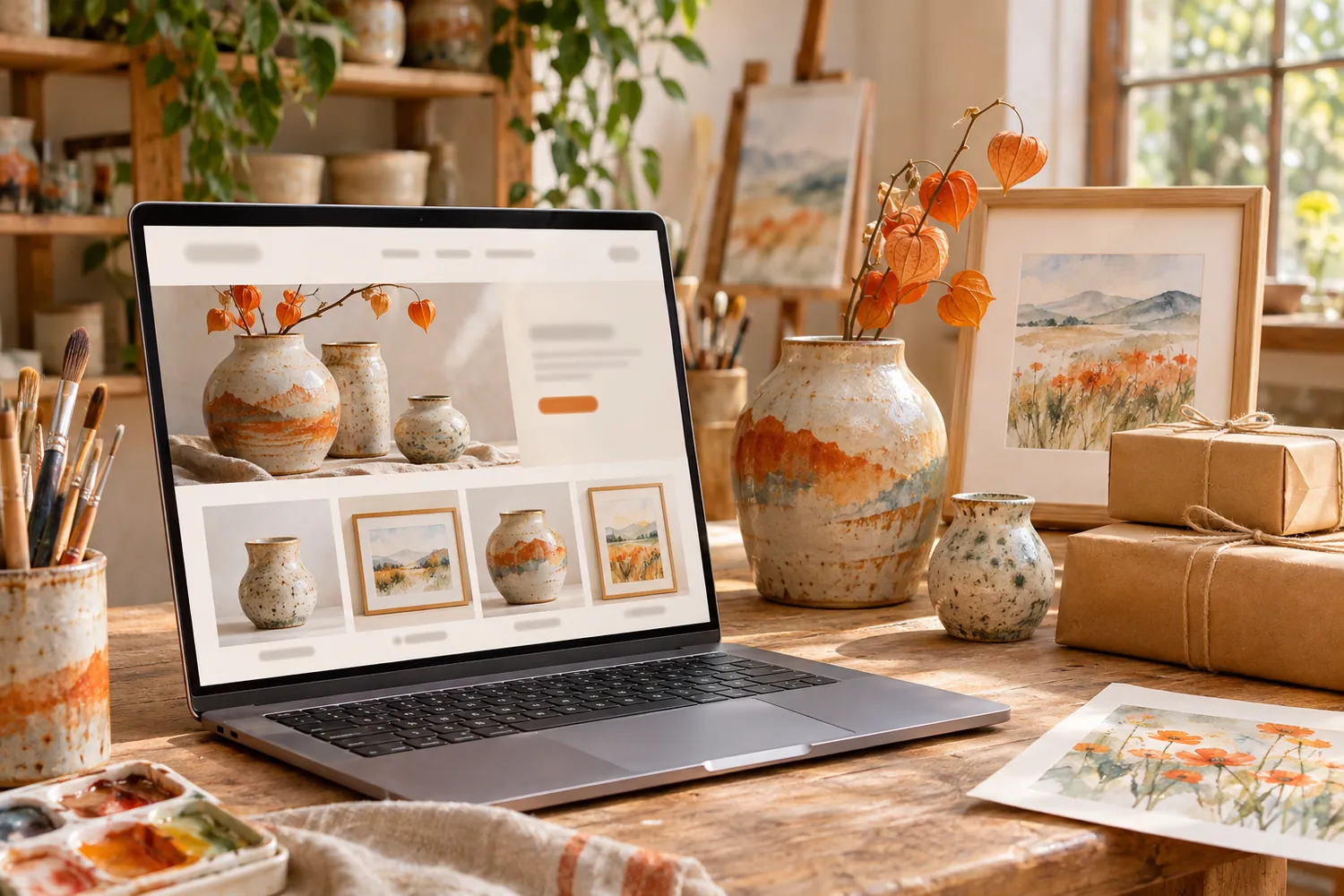
- Open your own shop as a second channel. You do not have to leave Etsy overnight. Your own shop gives you a place where the rules, prices and content licence are set by you, no matter what the next terms update says.
What your own shop gives you that Etsy cannot
- Control over your content. On your own website you decide who may use your photos and descriptions. You can ask known AI crawlers to stay away in your
robots.txtfile (example below). The big companies respect it, though not every bot on the internet does, so treat it as protection, not a guarantee. - A legal reservation that counts in the EU. Under Article 4 of the EU Copyright Directive (2019/790), AI companies may mine publicly available content only if the rights holder has not reserved those rights in a machine-readable way. The EU AI Act requires providers of general-purpose AI models to respect such reservations. A clear reservation on your own site has real legal weight. On Etsy, you have already granted a licence, so it does not help there.
- Customers who buy from you. On a marketplace, people buy „on Etsy”. In your shop they buy from you, and you can invite them to your newsletter and sell to them again without paying a commission.
- No competitors on your page. Etsy shows similar items from other sellers next to yours. In your own shop, visitors see only your work.
- No commission on every sale. You pay a fixed amount for the shop, plus your payment provider’s card fee.
- Independence from the next change. Marketplace fees, search algorithms and terms can change at any time. Your domain, your shop and your customer list stay.
Here is a typical robots.txt block that asks the main AI training crawlers not to collect your pages. Blocking Google-Extended does not remove you from normal Google Search.
User-agent: GPTBot
Disallow: /

User-agent: ClaudeBot
Disallow: /

User-agent: CCBot
Disallow: /

User-agent: Google-Extended
Disallow: /
Etsy fees in 2026: what you actually pay per sale
Etsy’s fees as reported in 2026 fee guides (check Etsy’s Fees & Payments Policy for current rates, because they depend on your country and do change):
- Listing fee: $0.20 per listing, renewed every four months or when the item sells.
- Transaction fee: 6.5% of the order total, including shipping and gift wrap.
- Payment processing: depends on where your bank account is. About 3% + $0.25 in the US, 4% + £0.20 in the UK and 4% + €0.30 in many EU countries.
- Offsite Ads: 15% of a sale that came from an Etsy ad on sites like Google, Instagram or Pinterest, or 12% for shops above $10,000 a year, capped at $100 per order. Above $10,000 in sales over 12 months, taking part is mandatory.
- Extras in some cases: a 2.5% currency conversion fee if your listing currency differs from your bank’s, a regulatory operating fee in the UK, France, Italy, Spain and some other countries, and VAT on Etsy’s fees for sellers in the UK and EU.
Example for a €50 order in the EU: 6.5% transaction fee (€3.25), payment processing (€2.30) and the listing fee (about €0.18) add up to about €5.73, or 11.5%. If the order came through Offsite Ads, add another €7.50, and Etsy keeps about €13.23, or 26.5%. In the US the same $50 order costs about $5.20 in fees before ads.
Over a month: 20 orders of €50 cost you about €115 in Etsy fees, or about €150 if a quarter of them came from Offsite Ads. Your own shop costs €20.99 a month plus your card fees. With Stripe’s standard rate for European cards (1.5% + €0.25), that is about €1 per order, so €41 for the same 20 orders.
To be fair: at very low volume, Etsy is cheaper. From roughly five €50 orders a month, your own shop starts to cost less in fees. The real difference is traffic, which is why the table below has a row for it.
| Etsy | Shopify (Basic) | Your own shop by WebsButler | |
|---|---|---|---|
| Fixed cost | $0.20 per listing, every 4 months or per sale | $39 a month ($29 a month billed yearly), plus any paid apps and themes | €20.99 a month (first month €0) or €559 once |
| Fee on each sale | 6.5% + payment processing + 12–15% Offsite Ads on ad sales | 2.9% + 30¢ with Shopify Payments (US), plus 2% with other payment providers | No commission to me, only your payment provider’s fee |
| Who builds it | Etsy’s standard shop layout | You, from a theme | I design and build it around your work |
| Your photos and AI | Licensed to Etsy, its partners and vendors, including for AI training | Covered by Shopify’s own terms (read them) | You decide; AI crawler rules on request |
| Customer relationship | Through Etsy, on Etsy’s rules | Yours | Yours, with your own mailing list |
| Traffic | Etsy search brings buyers | You bring it | You bring it (Google, social media, email); I set up the SEO basics |
| Help after launch | Etsy support | Shopify support, apps, freelancers | 1 change a month included, direct contact with me |
One honest point: Etsy brings buyers, and a new shop starts with no traffic. That is why the strongest setup for most makers uses both. Etsy stays your shop window for new customers, while returning buyers, custom orders and your best pieces go to your own shop.
Etsy alternatives: where else can you sell?
If you are looking at sites like Etsy, the options fall into three groups:
- Other marketplaces such as eBay, Amazon Handmade, or Folksy and Not On The High Street in the UK. They bring their own buyers, but they also take commission and have their own content licences. Before you move, read the section of their terms about what they may do with your photos.
- Do-it-yourself shop builders such as Shopify, Squarespace, Wix or Big Cartel. You get your own shop, but you build and maintain it yourself, and monthly plans plus paid apps add up.
- A shop built for you. You send your products and photos, a designer builds the shop, and someone looks after it after launch. That is what I do, and it is described in the next section.
Whatever you choose, the principle is the same: do not keep your whole business in one place whose rules you cannot influence.
How to move to your own shop, step by step
- Pick a domain with your studio name or your own name. You can keep a domain you already own wherever it is now.
- Move your best products first from your Etsy backup: photos, descriptions, variations. Rewrite the descriptions for Google while you are at it, because Etsy search and Google search reward different things.
- Set up payments and shipping: card payments (for example Stripe or PayPal), shipping zones and rates, returns and your shop’s terms. If you sell to customers in the EU, they usually have 14 days to withdraw from a purchase, though made-to-order and personalised items are an exception.
- Get found on Google and Pinterest: product structured data, image alt text, and free product listings through Google Merchant Center. Claim your website on Pinterest, so your pins link back to your shop.
- Tell people where it is allowed: on social media, in your newsletter, at craft fairs, and in parcels you ship from your own shop.
Your own online shop for €20.99 a month or €559 once
I design and build online shops for artists, makers and small studios. The online shop package costs €20.99 a month (with the first month at €0) or €559 one-off, and includes:
- a shop with unlimited products, a basket and online payments ready to go,
- a design made around your work, not a template you have to fill in yourself,
- hosting, an SSL certificate, backups and protection against attacks,
- a company e-mail address on your domain,
- Google Analytics and the Meta Pixel set up, plus short video guides to editing your shop,
- one free change a month after launch,
- your domain your way: keep it with your current provider, transfer it to me, or I buy a new one for you (free for the first year),
- the first draft of your shop within 10 working days of receiving your materials,
- on request, AI crawler rules in
robots.txtand a machine-readable reservation of your rights.
With the one-off payment, the shop is yours from day one, and from the second year you pay €84.99 a year for hosting. With the subscription you can cancel whenever you want. During the subscription the shop belongs to WebsButler, and you can buy it out at any time for the package’s base price.
All prices are final: I add no VAT and no setup fee. I work fully online and in English, so it makes no difference where in the world you are. WebsButler is based in Poland, so the order form charges the złoty equivalent (90 PLN a month or 2,400 PLN once) and your card converts it.
Order your online shop → Choose the shop package, tell me about your work in a few sentences, and I take care of the rest. Want to compare first? See all packages and prices.
Frequently asked questions
When does Etsy’s new AI policy take effect?
Etsy’s updated Terms of Use take effect on 16 December 2026. If you keep selling on Etsy after that date, you accept a licence that lets Etsy, its partners and its vendors use your content to develop and train AI.
Will Etsy use my photos to train AI?
The licence allows it. After the 23 November revision, Etsy promises not to train models designed to copy your work or replace your creativity, but it can still train models that improve its services, such as search, recommendations, ads and translation.
Can I opt out of Etsy AI training?
There is no opt-out setting. The reference to opt-out rights was removed in the 23 November version. Sellers in the EU and UK can object to some processing of their personal data under GDPR by writing to Etsy’s data protection officer, but that right may not cover photos of your products or your designs.
Does deleting my listings or closing my Etsy shop stop it?
Not necessarily. The licence is described as perpetual and irrevocable, so analysts warn that deleting listings may not remove Etsy’s rights to content it already has. Etsy has not clearly explained what happens to deleted content.
Should I leave Etsy?
Not necessarily. For many makers the best setup is both: Etsy brings new buyers, and your own shop builds your brand, your mailing list and commission-free sales.
What are the best Etsy alternatives?
Other marketplaces (eBay, Amazon Handmade, Folksy or Not On The High Street in the UK), do-it-yourself shop builders (Shopify, Squarespace, Wix, Big Cartel), or your own shop built and maintained for you. Before you move, read how each platform may use your photos.
How much does my own online shop cost with WebsButler?
€20.99 a month with the first month at €0, or €559 one-off with the first year of hosting included and €84.99 a year after that. Products are unlimited, and I take no commission on your sales.
Can I block AI bots on my own website?
Yes. Rules in your robots.txt file ask known AI crawlers such as GPTBot, ClaudeBot, CCBot and Google-Extended not to collect your pages. Major companies respect them, though not every bot does. In the EU, a machine-readable reservation of your rights also has legal weight under the Copyright Directive.
Can you build a shop for me if I don’t live in Poland?
Yes. Everything happens online and in English, wherever you are. You pay by card, and the order form charges the złoty equivalent of the price.
Selling on Etsy and wondering whether your own shop makes sense for you? Write to me or order your online shop. The first month of the subscription is €0.

Sources
- Etsy Community: Updated Nov 23, Our recent Terms of Use update
- Value Added Resource: Etsy Revises AI Training Terms Following Seller Backlash (23 Nov 2026)
- Value Added Resource: Etsy Expands AI Training Rights Over Seller Content (29 Oct 2026)
- PYMNTS: Etsy Rewrites AI Training Terms After Sellers Close Shops (24 Nov 2026)
- The Next Web: Etsy will revise its AI training terms after sellers close their shops (21 Nov 2026)
- Engadget: Etsy says it will not use sellers’ content to train AI
- Etsy: Terms of Use and Etsy: Fees & Payments Policy
- Etsy Help: How Etsy’s Offsite Ads work
- EUR-Lex: Directive (EU) 2019/790 on copyright in the Digital Single Market